The 5 essential Google Sheets templates that separate organised coaches from chaotic ones. Client tracker, macro calculator, check-in system, training planner, and business dashboard.
Every online fitness coach hits the same wall. You start with a handful of clients and a cobbled-together spreadsheet. Then you hit 15 clients. Then 30. Suddenly you are drowning in tabs, copy-pasting macros at midnight, and praying you did not send the wrong nutrition plan to the wrong person.
The fix is not another app with a monthly fee. It is five well-built Google Sheets templates that talk to each other and do the heavy lifting for you. Below are the exact coaching spreadsheet templates that separate the coaches who scale from the ones who stall.
1. Client Management Dashboard
What it does: A single-view command centre that shows every active client's status, contract dates, compliance scores, and next action items without opening a single individual file.
Why you need it: When you are managing 20+ clients, you cannot afford to click into each person's sheet to figure out who needs attention. A dashboard surfaces the critical information so you can triage your day in under five minutes.
What to include:
- Columns: Client Name, Start Date, Contract End Date, Package Tier, Check-In Compliance (%), Current Goal, Status (Active / Paused / At Risk), Last Contact Date, Next Action
- Key formulas: Use
COUNTIFto calculate compliance rates from check-in data,DATEDIFto flag contracts expiring within 14 days, and conditional formatting to highlight at-risk clients in red - Bonus: Add a
SPARKLINEcolumn that shows each client's bodyweight trend over the last 8 weeks at a glance
Why it saves time: Instead of opening every client file, the dashboard gives you one place to decide who needs attention and what needs to happen next.
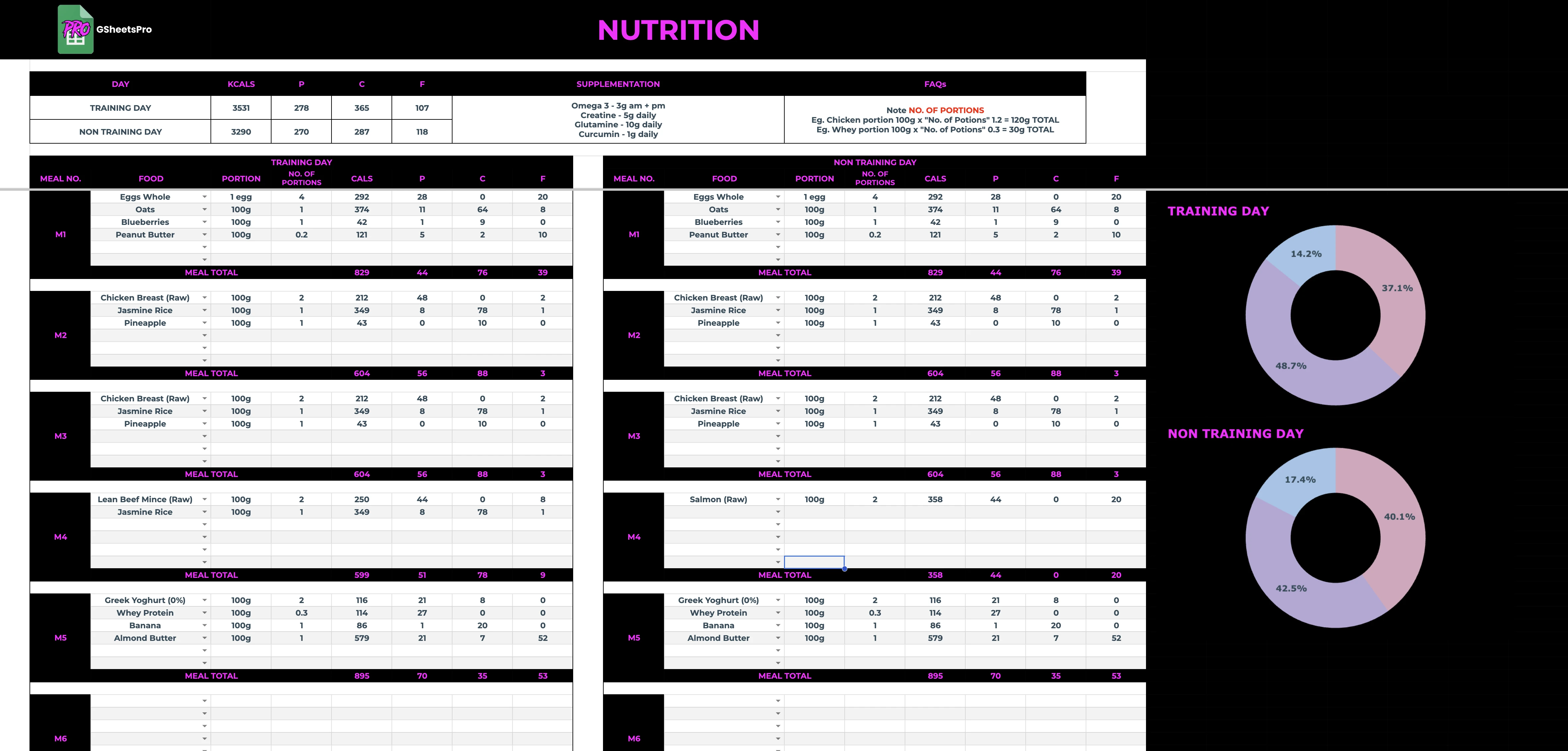
2. Macro & Nutrition Calculator
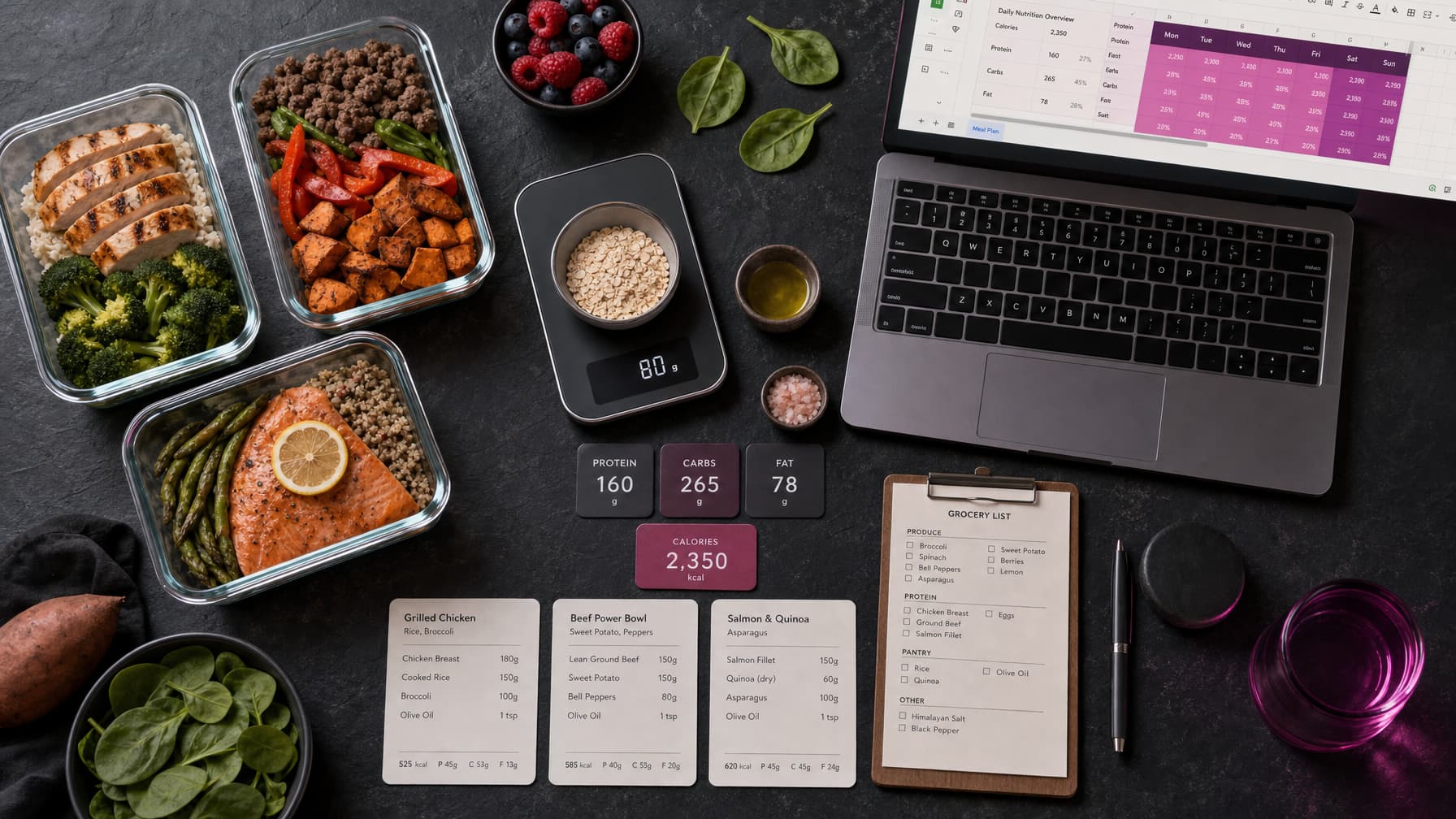
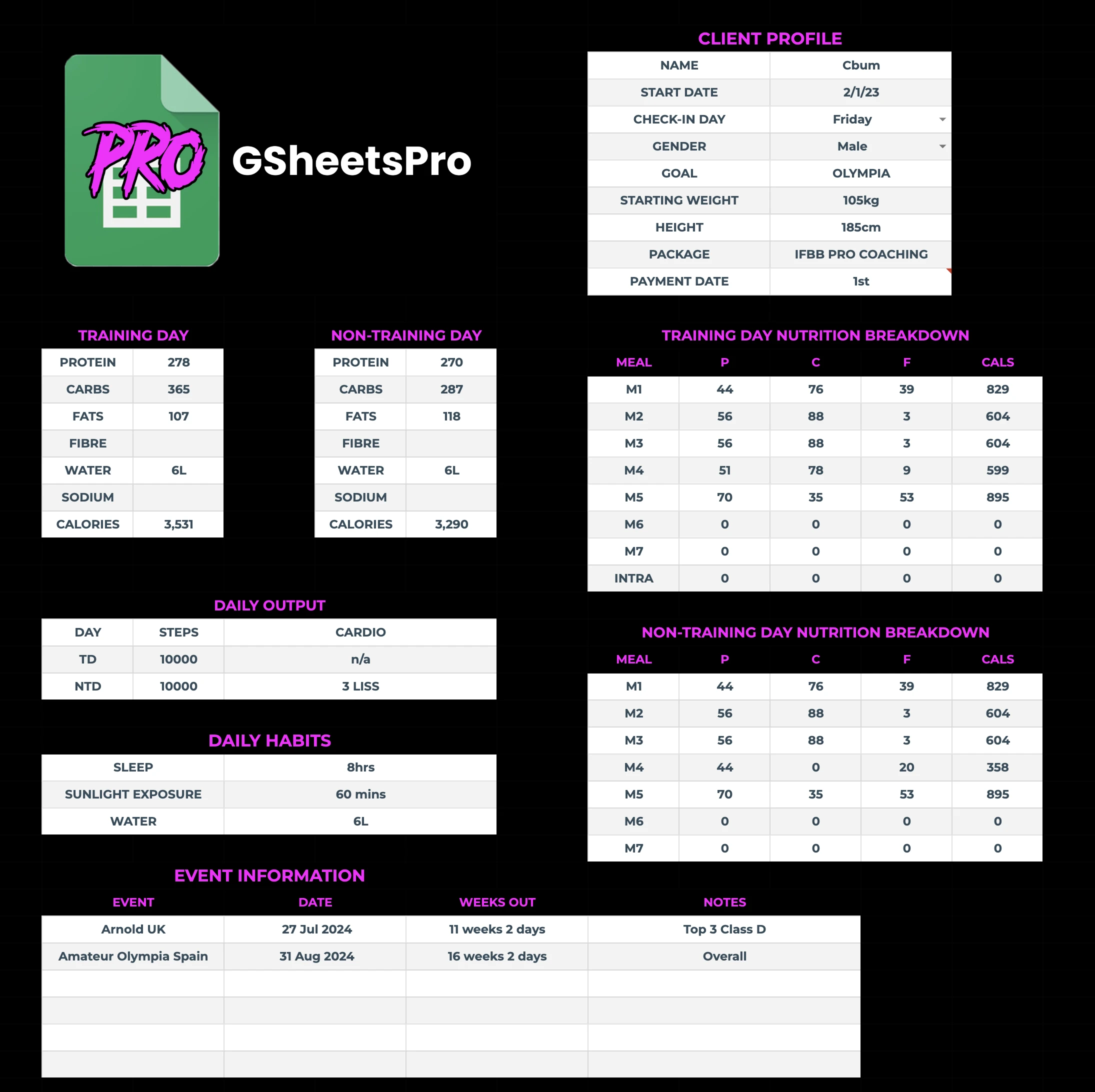
What it does: Takes a client's stats (weight, height, age, activity level, goal) and spits out precise calorie and macronutrient targets with automatic adjustments for training and rest days.
Why you need it: Calculating macros by hand for every client (and recalculating every time they hit a plateau) is tedious and error-prone. One wrong number and your credibility takes a hit.
What to include:
- Input fields: Bodyweight (kg/lbs toggle), Height, Age, Sex, Activity Multiplier (dropdown: sedentary through to very active), Goal (fat loss / maintenance / muscle gain)
- Calculation engine: Mifflin-St Jeor for BMR, activity multiplier for TDEE, then goal-specific deficit or surplus percentages. Use
IFandVLOOKUPto auto-select multipliers from a reference table - Output columns: Training Day Calories, Rest Day Calories, Protein (g), Carbs (g), Fat (g), Fibre Target (g)
- Refeed logic: A toggle that automatically calculates higher-carb refeed day macros based on the client's current deficit
Why it saves time: Update one input and the connected targets recalculate without rebuilding the plan by hand.
3. Weekly Check-In System
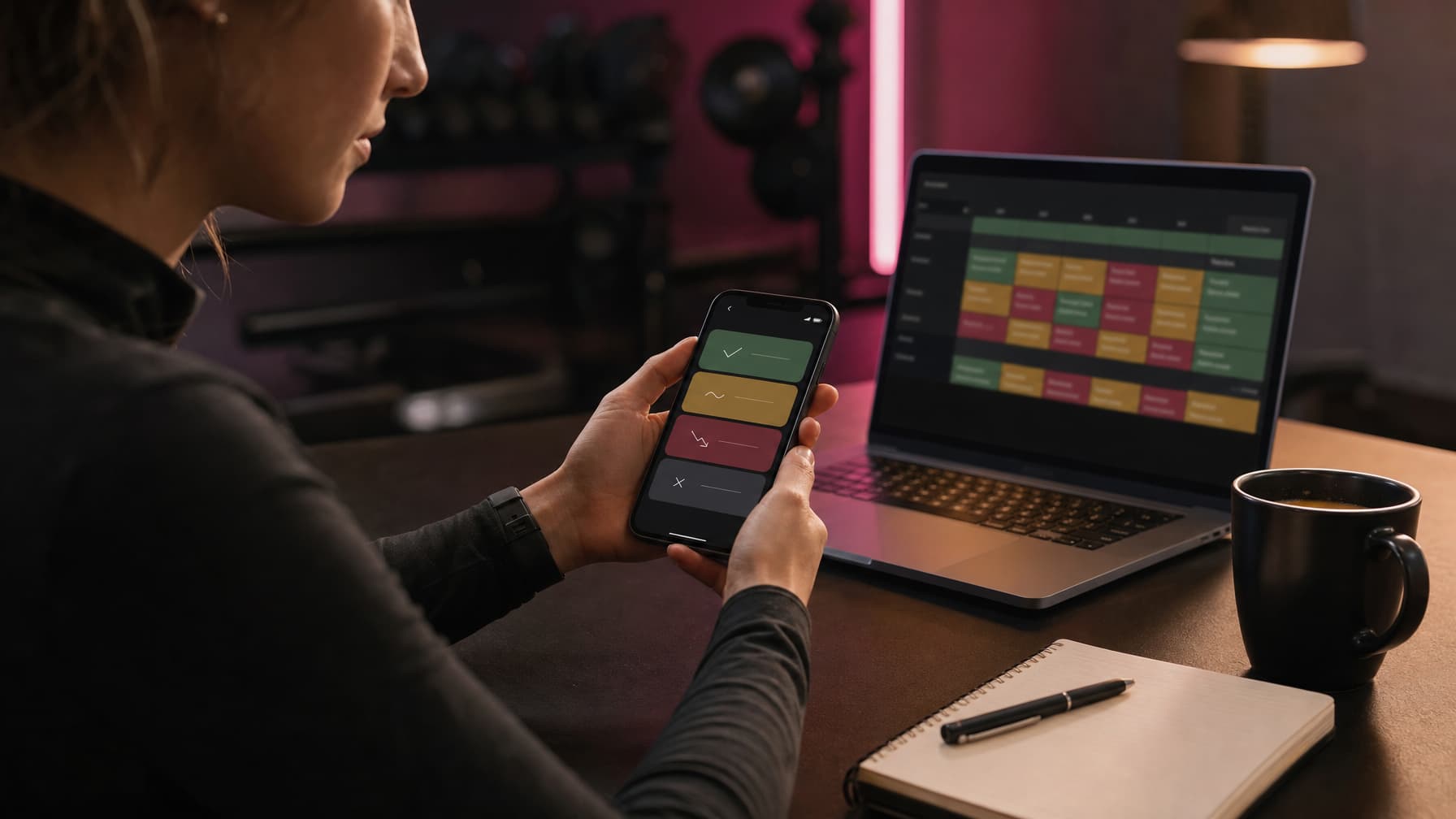
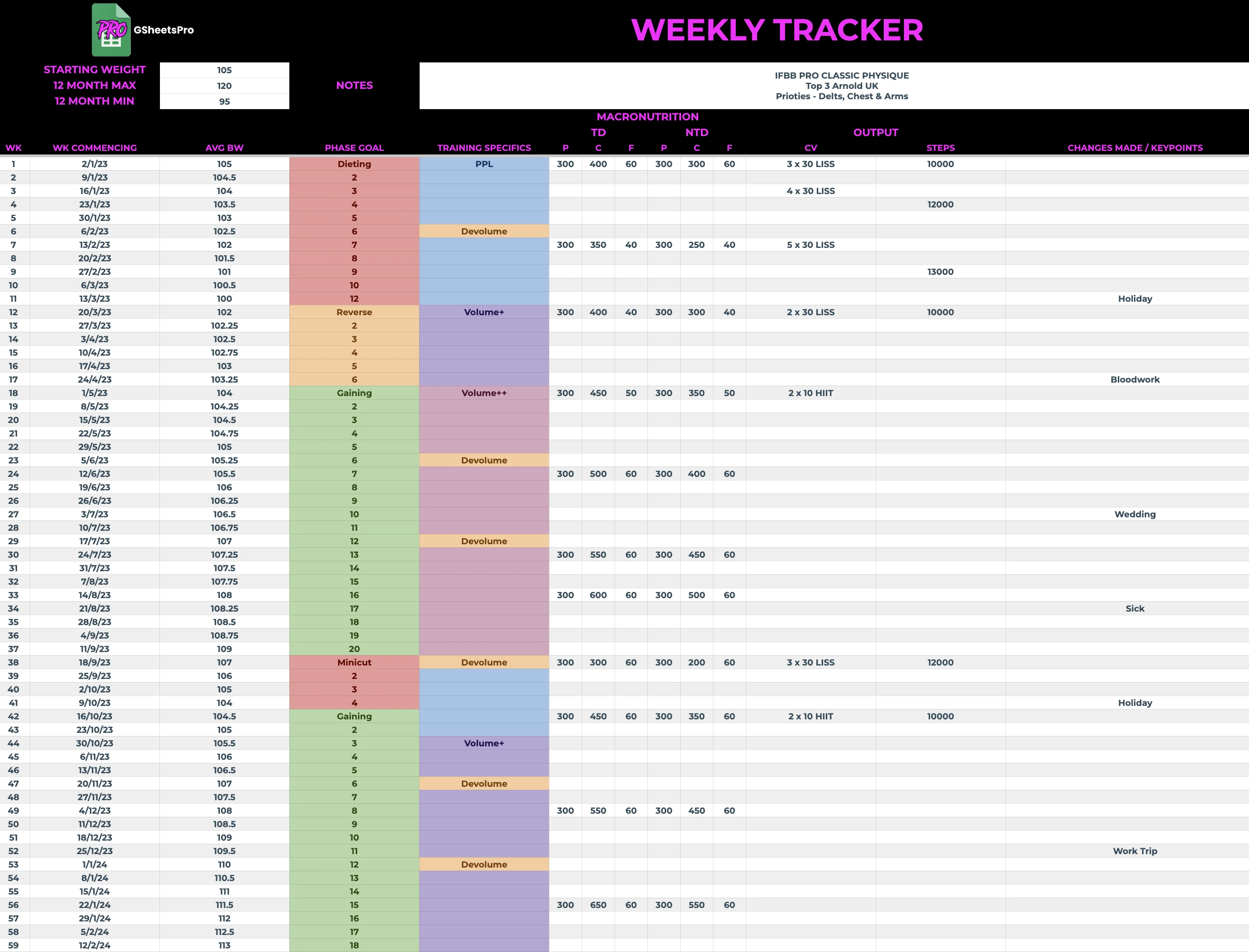
What it does: A structured form-to-dashboard pipeline where clients submit weekly data (weight, photos, adherence scores, energy, sleep, stress) and it flows directly into a tracking sheet with trend analysis.
Why you need it: Check-ins are the backbone of online coaching. Without a system, responses arrive in random formats across email, WhatsApp, and DMs. You waste time chasing, reformatting, and trying to spot patterns manually.
What to include:
- Client-facing fields: Week Number, Bodyweight, Average Daily Calories, Protein Hit (Y/N), Training Sessions Completed, Sleep Quality (1-10), Stress Level (1-10), Energy (1-10), Wins This Week, Struggles This Week
- Coach-side dashboard: Rolling 4-week averages for weight, calories, and adherence. Use
AVERAGEwithOFFSETfor rolling windows. Conditional formatting flags any metric that drops below threshold (e.g., sleep under 5 for two consecutive weeks) - Trend charts: Embedded
SPARKLINEor linked Charts for bodyweight, compliance, and subjective wellbeing over the full coaching period - Auto-generated summary: A formula-driven text block that reads: "Weight trend: [up/down/stable]. Adherence: [X]%. Flag: [sleep declining]." This gives you a quick snapshot before you record your Loom reply
Why it saves time: Responses land in one consistent structure, ready to review without reformatting messages from different channels.
4. Training Program Builder
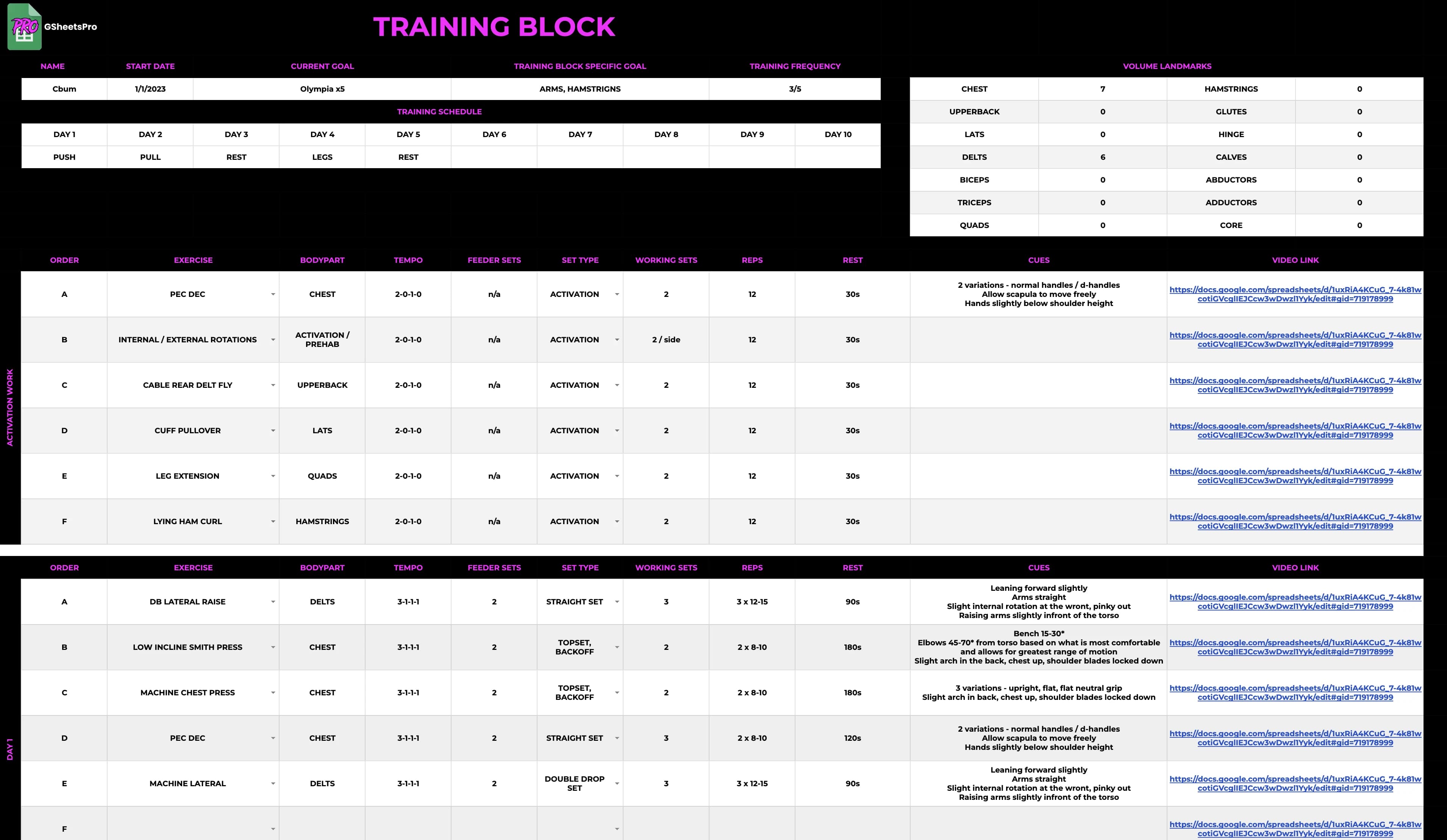
What it does: A library-driven program design tool where you select exercises from a database, assign sets, reps, RPE, and tempo, and the sheet auto-generates a client-ready training plan with progressive overload built in.
Why you need it: Writing programs from scratch every mesocycle is one of the biggest time sinks in coaching. A template with an exercise library and auto-progression means you design once and the system handles the increments.
What to include:
- Exercise library tab: Exercise Name, Primary Muscle Group, Equipment Required, Movement Pattern (push / pull / hinge / squat / carry), Video Link. Aim for 150+ exercises to cover most programming needs
- Program builder tab: Day, Order, Exercise (dropdown from library), Sets, Reps, RPE / RIR, Tempo, Rest Period, Coach Notes
- Progressive overload engine: A
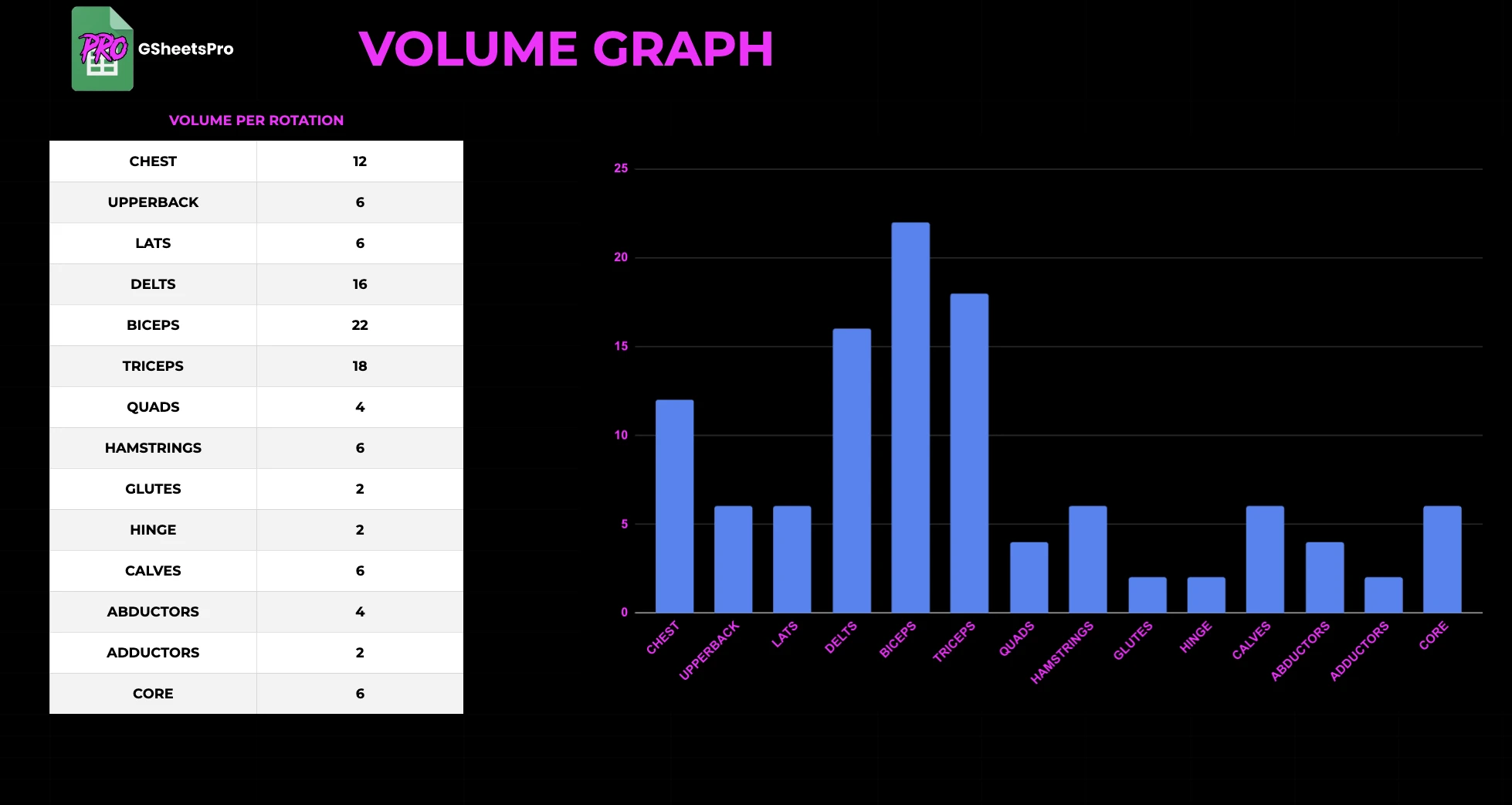
Week-over-Weekcolumn that auto-calculates load increases based on your chosen progression model (e.g., +2.5% on compounds, +1 rep on isolations). UseIFlogic tied to the client's training log to determine whether progression is warranted - Volume tracking: Auto-summing weekly sets per muscle group with a target range (e.g., 10-20 sets for quads). Conditional formatting turns the cell amber when approaching the upper limit and red when it exceeds it
- Deload logic: A checkbox that drops volume by 40% and intensity by 10% across the board for recovery weeks
Why it saves time: Reuse your exercise library and progression logic instead of rebuilding every programme from a blank sheet.
5. Business Analytics Dashboard
What it does: Pulls data from your other four templates and consolidates it into a single business overview: revenue, client count, retention rate, average lifetime value, capacity, and lead pipeline.
Why you need it: You are not just a coach. You are running a business. If you do not know your churn rate, your cost per acquisition, or how close you are to capacity, you are flying blind. This template turns scattered data into decisions.
What to include:
- Revenue section: Monthly Recurring Revenue (MRR), Average Revenue Per Client, Total Revenue This Month, Revenue vs. Target (%). Use
SUMIFSto pull from your client management dashboard based on active status and package tier - Retention metrics: Churn Rate (%), Average Client Lifespan (months), Renewal Rate (%), Clients Lost This Month.
COUNTIFSpaired with date ranges gives you month-over-month retention without any manual counting - Capacity planning: Current Clients, Max Capacity, Utilisation (%), Projected Revenue at Full Capacity. A simple division formula that tells you exactly how much room you have to grow before you need to hire or restructure
- Lead pipeline: Leads This Month, Discovery Calls Booked, Close Rate (%), Cost Per Acquisition. Track where every client came from (Instagram, referral, podcast) so you know where to double down
- KPI trends: Monthly
SPARKLINEcharts for MRR, churn, and client count so you can spot trends before they become problems
Why it saves time: Your key numbers stay in one view instead of being rebuilt manually whenever you need to make a decision.
The real cost of building these yourself
Each template can take hours to design, build, test, format, and connect. Across five systems, that becomes a substantial implementation project before you coach another client.
It is easy to start template one, get halfway through, and leave it unfinished when client work takes priority. The cost is not only the build time. It is staying with a fragmented system for longer than you planned.
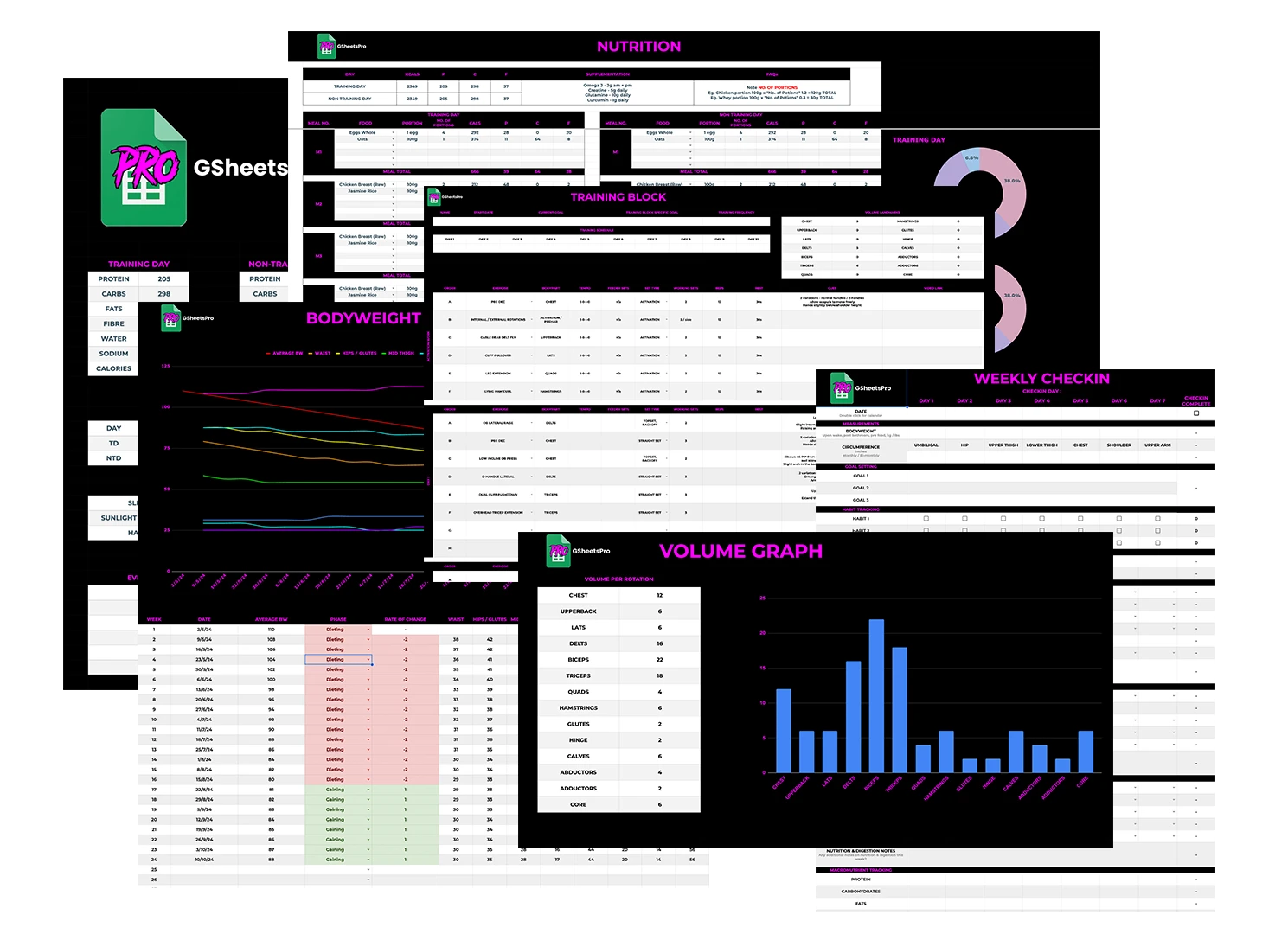
All five templates come pre-built in GSheetsPro for £199. Client dashboard, macro calculator, check-in system, program builder, and business analytics, connected and ready to duplicate for each client.
Or build them yourself. This guide gives you the structure. If you would rather start with the connected version, review the complete GSheetsPro system.