How to create a meal plan and nutrition tracking template in Google Sheets that works for online fitness coaches managing multiple clients.
Your clients don't fail because of bad training programmes. They fail because nutrition isn't tracked, meal plans aren't followed, and nobody catches the slip until it's been three weeks of missed macros.
The fix isn't another coaching app with a clunky food database. It's a Google Sheets meal plan template that you control, your clients understand, and your business can scale across dozens of athletes without breaking.
Here's how to build one from scratch — or skip to the end if you'd rather use one that's already done.
What a Coaching Meal Plan Template Actually Needs
Most meal plan templates you find on Etsy or Reddit are designed for individuals tracking their own food. That's not what you need. A coaching template needs to work for the coach managing 20, 30, or 50 clients at once.
That means:
- Per-client macro targets that adjust based on phase (cut, maintain, bulk)
- Weekly adherence tracking the coach can review at a glance
- Client-facing simplicity — your client sees a clean meal plan, not a wall of formulas
- Coach-facing data — you see compliance trends, calorie averages, and red flags
The best nutrition systems separate what the client sees from what the coach analyses. One shared tab for the client. One private dashboard for you.
Building the Template: Four Core Tabs
1. Client Setup
This is your configuration tab. For each client, define:
| Field | Example |
|---|---|
| Name | Sarah J |
| Goal | Fat loss |
| Phase | Cut — Week 6 |
| Daily calories | 1,850 |
| Protein (g) | 140 |
| Carbs (g) | 185 |
| Fat (g) | 62 |
| Meals per day | 4 |
| Preferences | No dairy, low gluten |
These values feed into every other tab. Change the macro targets here and the entire meal plan updates automatically. When a client moves from a cut to a reverse diet, you update one row — not an entire document.
2. Weekly Meal Plan
This is the client-facing tab. Keep it dead simple:
| Day | Meal 1 | Meal 2 | Meal 3 | Meal 4 | Daily Total |
|---|---|---|---|---|---|
| Mon | Eggs + oats (P: 35, C: 45, F: 15) | Chicken + rice + veg (P: 40, C: 50, F: 12) | Greek yoghurt + berries (P: 25, C: 20, F: 8) | Salmon + sweet potato (P: 40, C: 70, F: 27) | P: 140, C: 185, F: 62 |
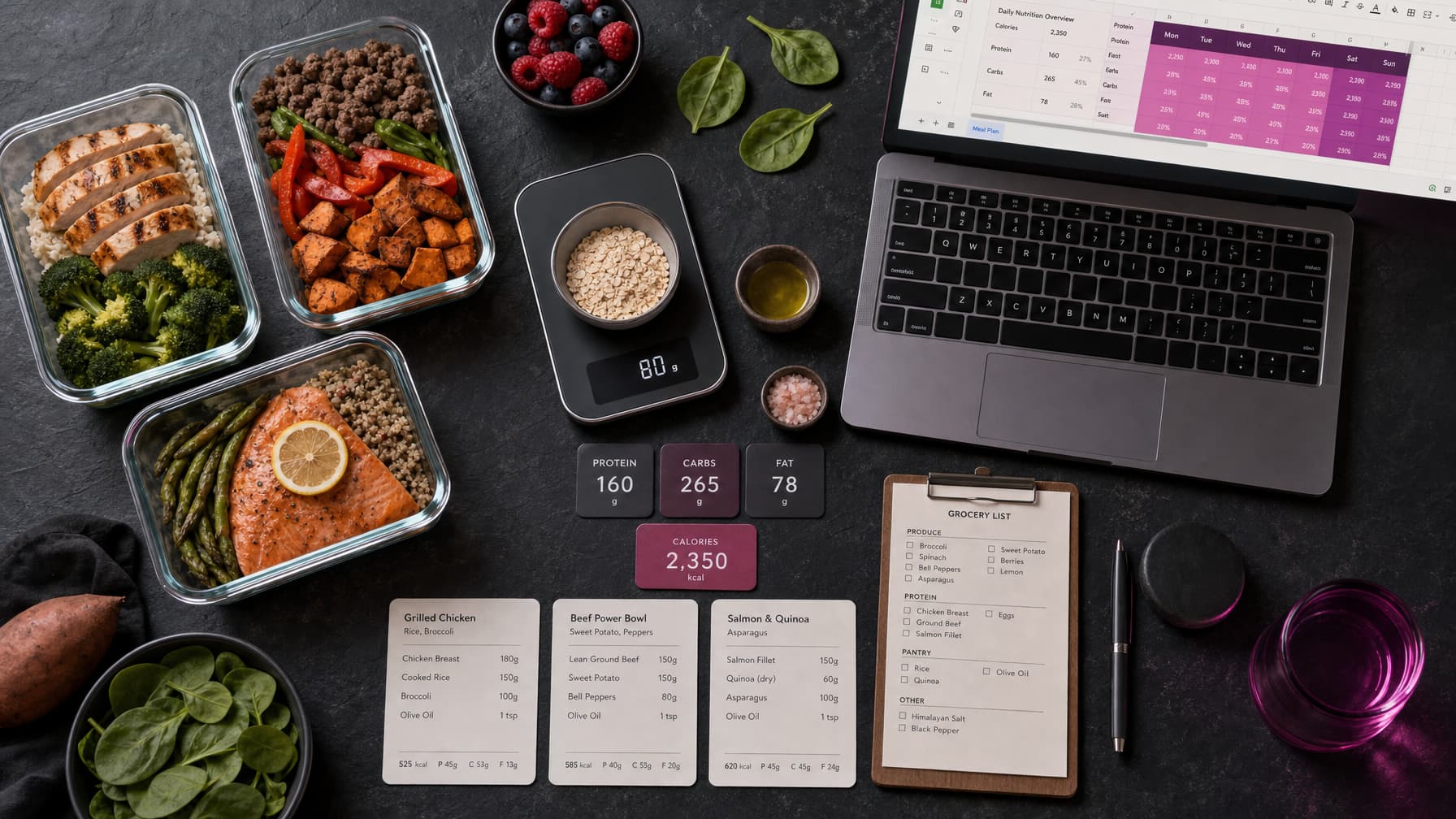
Each meal shows protein, carbs, and fat. The daily total auto-calculates and highlights green when it's within 5% of the target, amber within 10%, and red beyond that.
Your clients don't need to log food in an app. They follow the plan, tick off what they ate, and note any swaps. You review it during their weekly check-in.
3. Food Database
Build a simple lookup table of foods your clients commonly eat:
| Food | Serving | Calories | Protein | Carbs | Fat |
|---|---|---|---|---|---|
| Chicken breast | 150g | 248 | 46 | 0 | 5 |
| Basmati rice | 75g dry | 262 | 5 | 58 | 1 |
| Eggs | 2 large | 156 | 12 | 1 | 11 |
| Oats | 50g | 189 | 7 | 34 | 3 |
| Salmon fillet | 150g | 312 | 34 | 0 | 19 |
Use VLOOKUP or INDEX/MATCH to pull values into the meal plan tab. When you add a food to the database once, every client template can reference it. Over time, this becomes your coaching-specific nutrition library — far more useful than a generic database with 50,000 foods your clients will never eat.
4. Adherence Dashboard (Coach View)
This tab is for your eyes only. It pulls data from each client's meal plan to show:
- Weekly calorie average vs target (are they hitting it?)
- Protein consistency — the macro that matters most for body composition
- Adherence score — percentage of planned meals actually eaten
- Trend line — are they improving, maintaining, or slipping?
Conditional formatting makes this scannable in seconds. Green rows are on track. Red rows need your attention. You open this tab once a day and know exactly which clients to message.
This is the same principle behind building coaching systems that scale — automate the monitoring so you can focus your time on the coaching.
Scaling to Multiple Clients
Here's where most coaches get stuck. One meal plan template works. But duplicating it 30 times creates a maintenance nightmare.
Two approaches that work:
Option A: One spreadsheet per client. Duplicate your master template for each new client. They get their own Google Sheet with their meal plan and check-in tabs. You maintain a master client roster that links to each individual sheet. This gives clients a clean, private experience.
Option B: One master spreadsheet with per-client tabs. Faster to manage but less client-friendly. Works well if clients don't need direct access to the sheet. Better for coaches who deliver meal plans as PDFs or through a messaging app.
Most coaches doing 20+ clients use Option A. It's cleaner for the client and easier to archive when they finish their programme.
Tips That Save Hours
Use named ranges for macro targets. Instead of referencing B2 everywhere, name it protein_target. Formulas become self-documenting and harder to break.
Build a swap library. Clients will ask "can I swap chicken for turkey?" Create a tab of equivalent swaps so they can self-serve without messaging you every meal.
Colour-code phases. Cut phases get a blue header. Maintenance gets green. Bulk gets orange. When you open any client's sheet, you instantly know their current phase.
Template your common plans. If 60% of your clients start with the same fat-loss meal structure, save it as a template. Personalise the macros and food preferences — don't rebuild the entire plan each time.
For more templates that cover training plans, progress tracking, and client onboarding alongside nutrition, check out 5 Google Sheets templates every online fitness coach needs.
Skip the Build — Use What's Already Proven
Building a meal plan template from scratch takes 2–3 hours if you're comfortable with Sheets. Maintaining it, fixing formula errors, and scaling it across clients takes ongoing time.
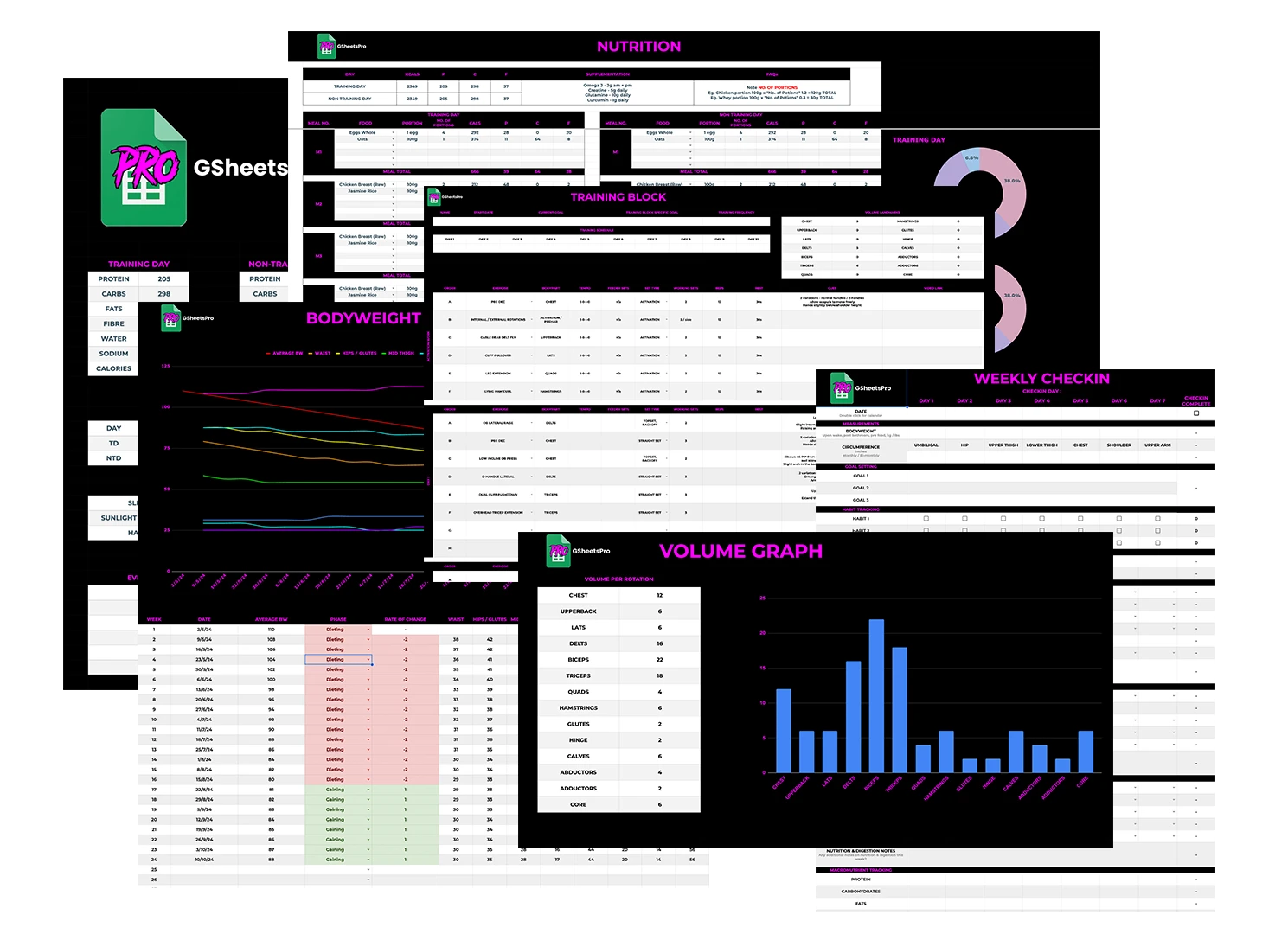
GSheetsPro includes a complete nutrition system — macro calculators, meal plan templates, adherence dashboards, and food databases — as part of the full coaching operating system. One-time £199, no subscriptions, and it's built specifically for online fitness coaches managing real client loads.